
 Image 1 of 1
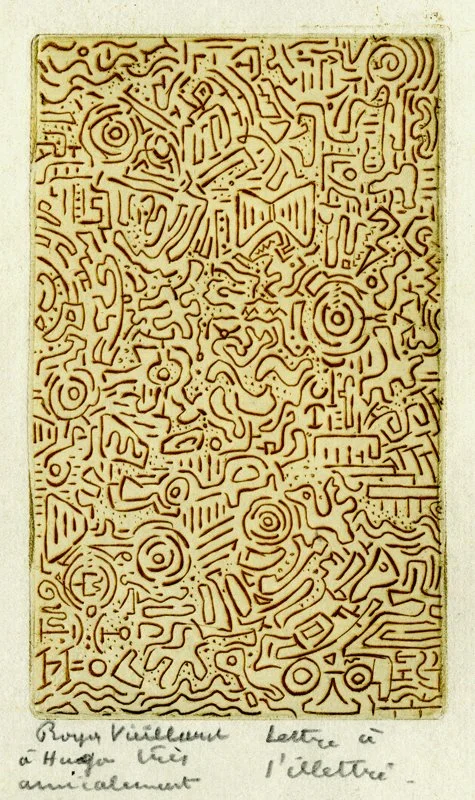
c. 1958
Color engraving
5.5” x 3.25”
Collection of Charles Dean & Sinan Karabas
A rare engraving in a gold ink that is dedicated to engraver Ian Hugo (from his estate), this small, patterned abstract is a departure from Vieillard's elaborate, surrealist architectural imaginings.
Roger Vieillard (1907–1989)
Roger Vieillard (full name Georges Marie Roger Vieillard) was a French burin engraver, illustrator, and graphic artist, closely associated with the New School of Paris. He was the son of a military officer and descended from the faience maker Albert Magimel, a friend of Ingres. Vieillard received a classical education in letters and law at the Sorbonne in Paris. In his military service as a meteorologist, he was stationed in Morocco, where he began sketching. He worked as a financial analyst at the Banque Nationale pour le Commerce et l’Industrie.
In the early 1930s, he met painter Jean Bazaine and English engraver Stanley William Hayter at Atelier 17, a pioneering experimental printmaking workshop. There, he discovered and mastered the burin technique, training under Hayter and Joseph Hecht. In 1939, he set up his first press and published his first illustrated book, Apollinaire’s Salomé.
Vieillard married American painter Anita de Caro in 1939, with whom he collaborated artistically. His work appeared in major international exhibitions, including the Venice Biennale (1948, 1950) and the São Paulo Biennial (1953–54).
In the early 1960s, he developed a plaster print technique.
Vieillard retired from the bank in 1967, became president of the Société Peintres-Gravures Français in 1970, and was elected to the Académie des beaux-arts. His works are held in major collections, including the National Gallery of Art in Washington, D.C., and the Metropolitan Museum of Art.
Vieillard’s career blends technical innovation in printmaking, literary illustration, and a deep engagement with modernist and symbolic themes, making him a significant figure in mid-20th-century French graphic art.