
 Image 1 of 1
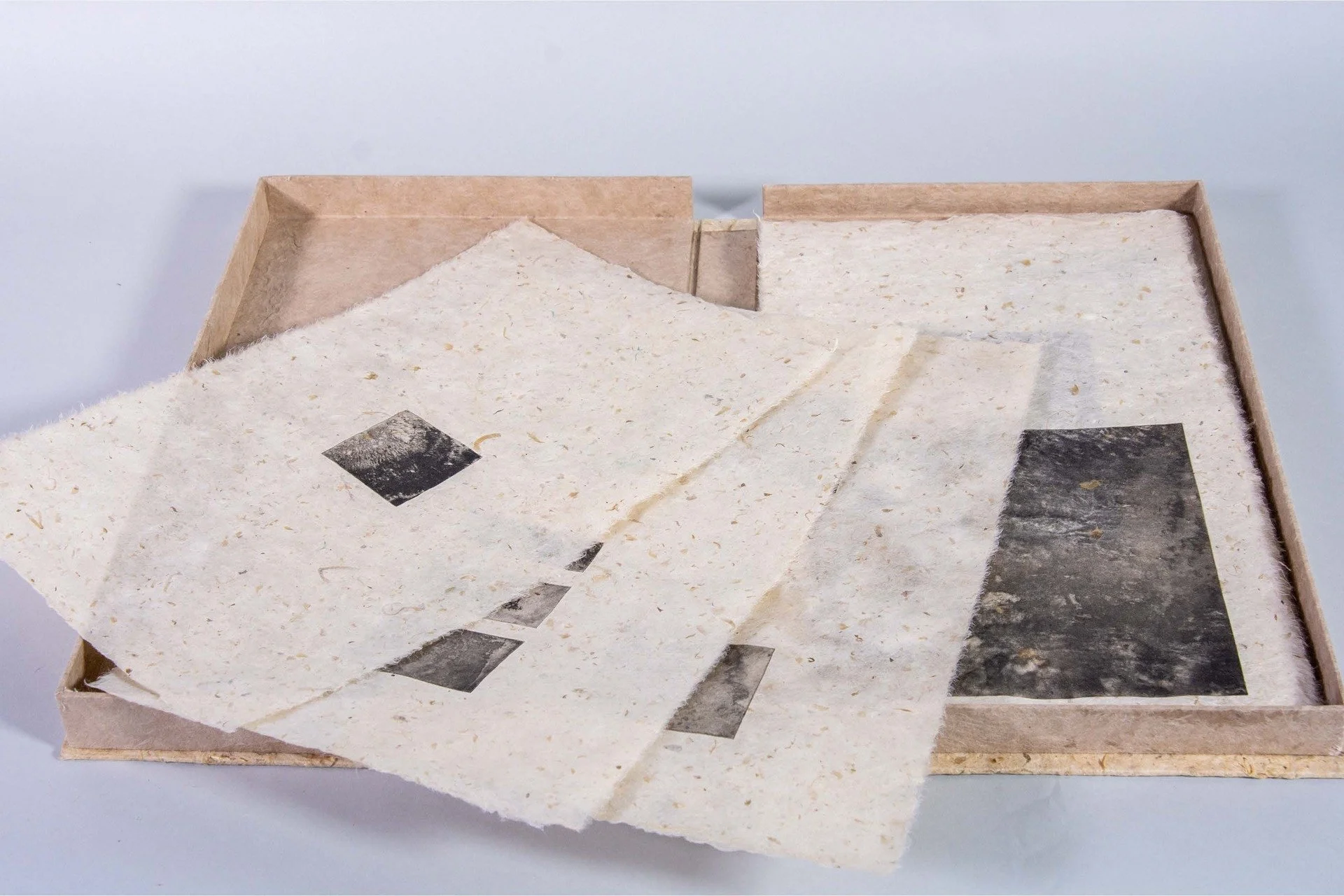
My practice centers on papermaking, printmaking, and artist books, exploring fiber as both image and language. I treat paper not simply as a surface, but as a material capable of holding memory, labor, and history. By making my own sheets from plant fibers, fungi, and other organic matter, I create works in which material and meaning are inseparable. My practice moves between the natural world, women’s histories, and overlooked forms of knowledge, considering cycles of life and death, presence and disappearance, fragility and resilience. My work with mushrooms and mycelium began through foraging and observing their structures under a microscope. Web-like gills, cellular lattices, and spore patterns became photographs that I later translated into copper-plate etchings. I printed these microscopic images onto paper handmade from shiitake mushrooms and kozo fiber. Papermaking is essential to this work because it allows me to construct the material foundation of the image myself. The process of breaking down, beating, and reforming fiber echoes the cycles of decomposition and regeneration that I observe in nature. The color, texture, translucency, and irregularities of each sheet remain visible, allowing the material to participate in the image rather than simply receive it. Printmaking expands this relationship between material, image, and transformation. I am drawn to the way an image changes as it moves through a plate, ink, pressure, and paper. Etching translates photographic information into lines, tones, and physical marks, while the handmade paper alters how those marks appear and are experienced. Rather than using printmaking primarily for reproduction, I approach each process as a form of translation. The distance between the original source and the printed impression creates space for an image to be fragmented, transformed, and reinterpreted. This process has become increasingly connected to my research into women’s visibility and erasure within Chinese history. I am particularly interested in women’s speech, testimony, and systems of communication such as Nüshu. Through papermaking and printmaking, I consider how histories that have been suppressed, fragmented, or forgotten can become materially present again. Repetition, impression, layering, and the transfer of an image from one surface to another parallel the ways memory and knowledge survive across generations. For me, printmaking is both a visual language and a way of thinking: it allows me to investigate what remains, what disappears, and how an image or a history can be carried forward through material and repeated acts of making.